
Where do Chicago chiropractic clinics quietly lose the most new patients? Not on Google, and not at the front desk — in the Instagram and Facebook DMs that nobody answers in time. A prospective patient in Lincoln Park sees your reel, taps “Message,” and asks “Do you take BCBS PPO?” at 8:14 PM. If the reply comes the next morning, they’ve already booked the clinic that answered in two minutes. The math is brutal and well-documented: contacting a web lead within five minutes instead of thirty makes you 21× more likely to qualify it (Lead Response Management study, Oldroyd/MIT–InsideSales), and 73% of consumers now expect a brand to respond on social within 24 hours — with the same share saying they’ll buy from a competitor if you don’t (2025 Sprout Social Index).
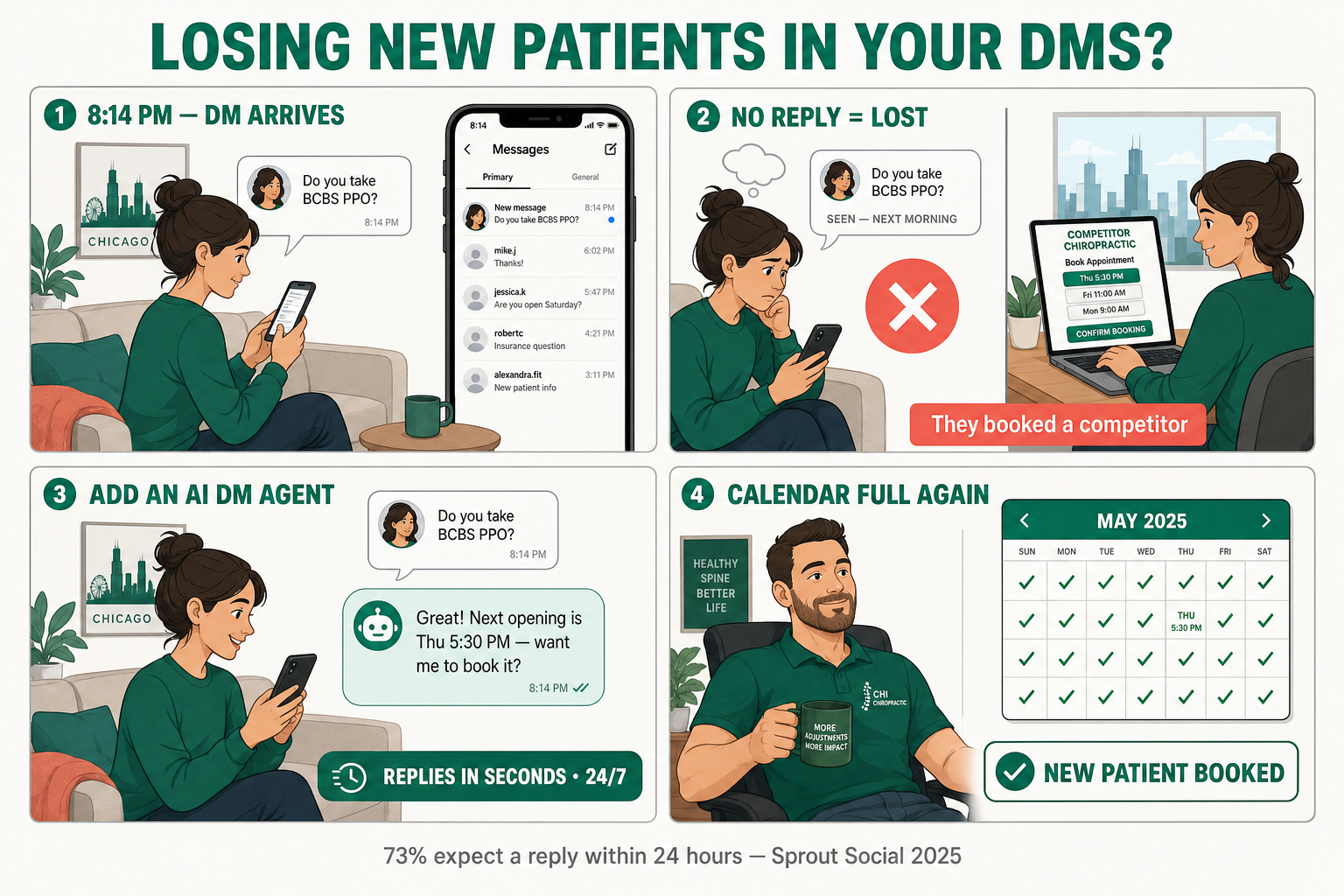
This is a playbook for Chicago clinic owners and the agencies that run marketing for them — practical, sourced, and specific to how patients actually behave in your DMs. We’ll show where the leak is, what it costs, and how an AI DM agent that answers Facebook and Instagram messages, qualifies the person, and books the appointment closes it. Every statistic is dated and linked.
Table of contents
- The short answer: why Chicago clinics leak patients in the inbox
- Five ways a chiropractic clinic loses patients in its DMs
- The cost of a slow reply, in real numbers
- Where your Chicago patients actually are
- What good looks like: the AI DM agent flow
- Doing it right in Chicago: local intent, HIPAA & TCPA
- DIY vs. done-for-you
- Frequently asked questions
The short answer: why Chicago clinics leak patients in the inbox
A chiropractic clinic’s Instagram and Facebook inboxes have quietly become a primary intake channel — and most clinics staff them like an afterthought. A patient who watches a posture reel or sees a five-star post doesn’t call; they message. That message is a high-intent lead, often arriving after 6 PM, and it decays by the minute.
The core problem is a mismatch between when patients reach out and when a front desk is available to reply. Your team is adjusting patients from 9 to 6, then goes home. Your DMs keep filling all evening. By the time someone opens the inbox the next morning, the person who asked “how much is a first visit?” has already scrolled to the next clinic and booked. Nothing looks broken — you just never see the patient you lost.
The good news: this is the most fixable leak in a clinic’s marketing, because the fix is speed, and speed is exactly what automation is good at. An AI DM agent answers Facebook and Instagram messages the moment they arrive, in your clinic’s voice, collects the person’s name, phone, and concern, and books the new-patient exam straight onto your calendar — day or night. It doesn’t replace your front desk; it covers the hours and the volume your front desk can’t.
Five ways a chiropractic clinic loses patients in its DMs
The leak isn’t one big hole — it’s five small ones that add up to a schedule that’s never quite full.
1. The after-hours message that sits until morning. The highest-intent messages arrive when you’re closed — evenings and weekends, right when back pain flares and someone finally decides to do something about it. A reply eight or twelve hours later lands after they’ve already booked elsewhere.
2. The “do you take my insurance?” question that goes cold. This is one of the most common pre-booking questions in chiropractic, and it’s binary: answer it fast and you often get the booking; answer it slow and you get nothing. A DM agent wired with your accepted-carrier list answers it in seconds and offers the next available exam.
3. Comment questions that never become conversations. Someone comments “is this safe during pregnancy?” under a reel. That’s a warm lead in public. If it’s ignored, it dies — and the algorithm reads the low engagement as a reason to show your content to fewer local people. (An AI comment agent that replies and moves the conversation to DMs fixes both problems at once.)
4. One person trying to watch too many inboxes. A modern clinic is reachable on Facebook, Instagram, Google, and its website chat at minimum. No single front-desk staffer can watch all of them while checking patients in. Messages slip not from neglect but from human bandwidth.
5. Replies that capture instead of book. Even clinics that do reply often just “capture” — a name and number to “follow up on later.” That follow-up frequently never happens, or happens too late. The job of the first reply is to book the exam, not to add a task to a list.
The cost of a slow reply, in real numbers
Slow replies aren’t a soft “customer experience” problem — they’re a measurable revenue leak. The foundational data on lead response is stark. A Harvard Business Review audit of 2,241 U.S. companies found the average firm took 42 hours to respond to a web lead, and that firms responding within an hour were 7× more likely to have a meaningful conversation than those that waited just one hour longer — and 60× more likely than firms that waited a day or more (Harvard Business Review, 2011). The Oldroyd/MIT lead-response study put a finer point on it: reach out within 5 minutes rather than 30 and you’re 100× more likely to make contact and 21× more likely to qualify the lead (Oldroyd/MIT–InsideSales).
Patients now hold brands to that standard explicitly. In the 2025 Sprout Social Index, 73% of consumers said they expect a response within 24 hours, and 73% said they’ll simply buy from a competitor when a brand doesn’t respond on social (Sprout Social, 2025). Salesforce’s research is consistent: 71% of customers expect companies to communicate in real time (Salesforce, 2022). “Real time” is not what a busy front desk delivers at 9 PM.
Put it in clinic terms. Say your Instagram and Facebook bring in just 20 message inquiries a month — a conservative number for an active Chicago clinic. If half arrive after hours and go cold, that’s 10 lost conversations. If even three of those would have become new patients, and a chiropractic patient’s value runs well into four figures over a care plan, a single slow month can quietly cost more than a year of automation. That’s the leak hiding behind “we’re doing fine on social.”
Where your Chicago patients actually are
This matters precisely because the audience is enormous and local. According to Pew Research’s 2025 survey of U.S. adults, 71% use Facebook, 50% use Instagram, 84% use YouTube, and 33% use TikTok (Pew Research, 2025). Instagram skews young and mobile — 78% of 18–29-year-olds use it (Pew Research, 2024) — exactly the desk-worker, athlete, and new-parent segments a Chicago clinic wants to fill its calendar.
And they’re already messaging businesses at massive scale: people send roughly 1 billion messages a week to businesses across WhatsApp, Messenger, and Instagram, with Meta reporting more than 600 million chats a day between people and businesses on its apps (Meta, via TechCrunch, 2023). The DM isn’t a niche channel anymore; for a local service business it’s a primary one.
Local intent turns those messages into booked exams fast. Google’s research found that 76% of people who search for something nearby on a smartphone visit a related business within a day, and 28% of those searches lead to a purchase (Think with Google, 2016). Someone who watched your reel and then DMed “how soon can I get in?” is that patient — ready today, if you answer today. This is the same speed-to-lead principle that powers our missed-call text-back playbook and the first-visit funnel, applied to the social inbox instead of the phone.
What good looks like: the AI DM agent flow
An AI DM agent isn’t a chatbot that spits FAQs. Done right for a clinic, it runs the same qualify-and-book conversation your best front-desk person would — instantly, at any hour. Here’s the flow it should follow.
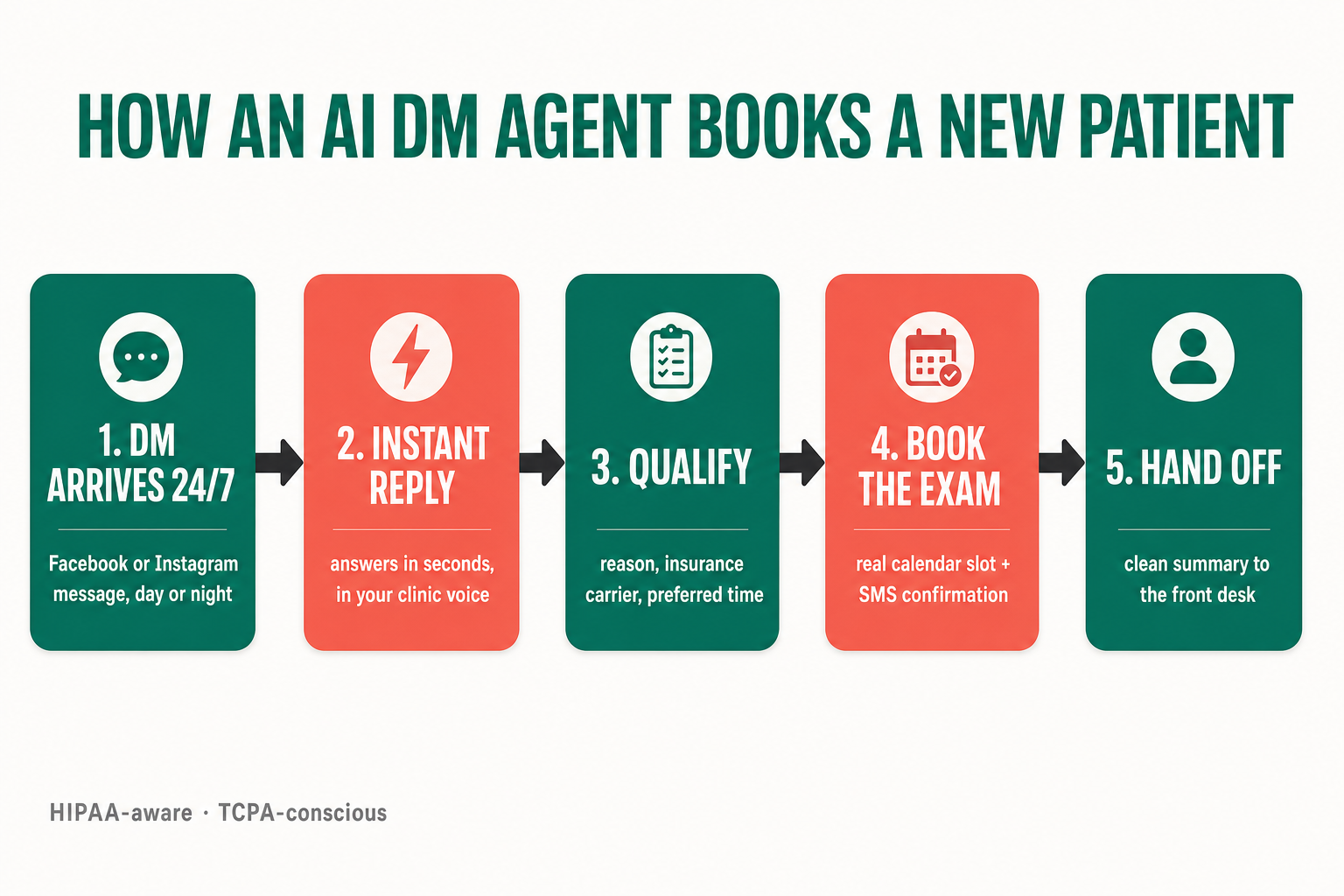
- Message arrives (24/7). A Facebook or Instagram DM — or a comment the agent moves into DMs — lands day or night.
- Instant, on-brand reply. The agent responds in seconds in your clinic’s voice, so the patient never feels handed to a machine.
- Qualify. It asks the three questions that matter: reason for visit, insurance carrier, and preferred day/time — and answers “do you take [carrier]?” from your accepted-carrier list.
- Book, don’t just capture. It offers real open slots from your calendar and confirms the new-patient exam inside the conversation, then sends an SMS confirmation.
- Hand off cleanly. The front desk gets a tidy summary — name, phone, concern, appointment — and steps in for anything sensitive (a PI case, a complaint, a complex verification). This is the same 80/20 handoff design that makes an AI receptionist work on the phones.
The same three agents can cover your other doors, too: a comment agent that keeps engagement (and local reach) alive under your posts, and an AI web-chat agent that books visitors on your website. One system, every inbox, one clinic voice.
Doing it right in Chicago: local intent, HIPAA & TCPA
Chicago is a big, competitive market — from the Loop to Naperville, patients have plenty of clinics a swipe away. That cuts both ways: high local intent means a fast, helpful DM reply converts well, but it also means a slow reply is instantly punished, because the next clinic is right there. Speed-to-reply is a local competitive advantage, not just a nicety. Pair it with a strong local SEO foundation so the reels and posts that generate those DMs actually reach nearby patients in the first place.
Two guardrails matter for any patient messaging, and they’re built into how a clinic-specific system should be configured:
- HIPAA-aware. The agent qualifies and books without pulling protected health information into plain social DMs. It collects what it needs to schedule and routes anything clinical to a secure, staff-handled channel.
- TCPA-conscious. Automated SMS confirmations and follow-ups run on proper consent, with clear opt-out. The point is fast, compliant communication — never spam.
None of this makes the clinic a healthcare provider or a substitute for clinical judgment. It’s an intake-and-scheduling system that behaves the way patients now expect a local business to behave: reachable, fast, and human-sounding, at 9 AM and 9 PM alike.
DIY vs. done-for-you
Could your front desk do all this by hand? In theory. In practice, replying to every DM within minutes, all evening and weekend, across Facebook, Instagram, and comments — while running a full clinic day — isn’t realistic, and hiring a dedicated social/community manager runs thousands a month. A designer, a video editor, a social manager, and a community manager together typically cost $4,000–$8,000 a month.
The done-for-you path folds content and the AI agents into one number: our social media service publishes 5 days a week across 9 channels and runs all three AI agents (comment, DM, and web chat) from $397/month, white-label, with no setup fees. That’s the difference between “we should really answer our DMs faster” and a system that simply does it — and books the patient — every single time. For the broader picture of how these channels feed a full schedule, see the 2026 chiropractic marketing statistics and the organic social-to-booked-exam playbook.
Frequently asked questions
Chiropractic Instagram & Facebook DM automation — FAQ
Why are chiropractic clinics losing new patients in their Instagram and Facebook DMs?
Because the highest-intent messages arrive after hours, and a slow reply loses the patient. Contacting a lead within 5 minutes rather than 30 makes you 21× more likely to qualify it (Oldroyd/MIT–InsideSales), and 73% of consumers expect a response within 24 hours — with 73% saying they'll buy from a competitor if a brand ignores them on social (2025 Sprout Social Index). A busy front desk simply can't answer every DM in minutes, so those patients book elsewhere.
What does an AI DM agent for a chiropractic clinic actually do?
It answers Facebook and Instagram direct messages the moment they arrive, in your clinic's voice, 24/7. It qualifies the person (reason for visit, insurance, preferred time), answers common questions like which carriers you accept, books the new-patient exam directly onto your calendar, sends an SMS confirmation, and hands the front desk a clean summary. It books, rather than just capturing a name to follow up on later.
Is automated patient messaging HIPAA-compliant and TCPA-compliant?
A properly configured clinic system is HIPAA-aware and TCPA-conscious: it qualifies and schedules without putting protected health information into plain social DMs, routes anything clinical to a secure staff-handled channel, and sends automated texts only with proper consent and a clear opt-out. It's an intake-and-scheduling tool — not a healthcare provider, and not a substitute for clinical judgment. Clinics remain responsible for operating within HIPAA, state board, and TCPA rules.
How many patients could a Chicago clinic really be losing this way?
It depends on message volume, but the leak is usually bigger than owners think. If an active clinic gets ~20 DM inquiries a month and half arrive after hours and go cold, that's 10 lost conversations monthly. Since a chiropractic patient's lifetime value runs well into four figures over a care plan, converting even a few of those recovers far more than the cost of automation.
Do I still need my front desk if I use an AI DM agent?
Yes — the agent covers the hours and volume your team can't, not your team. It handles the routine, high-speed qualify-and-book conversations 24/7 and hands anything sensitive (personal-injury cases, complaints, complex insurance verifications) to a human with full context. It's the same 80/20 handoff model that makes an AI phone receptionist effective.
How fast can this be set up, and what does it cost?
Our done-for-you social media service includes all three AI agents (comment, DM, and web chat) plus content across 9 channels from $397/month, fully white-label with no setup fees. It's wired to your calendar and clinic voice as part of onboarding, so you're answering and booking DMs automatically rather than manually chasing your inbox.
About the author
Derek Osei is the Local Marketing & Reviews Specialist on the GHL Chiropractor Snapshot team, based in Tampa, FL. He builds the Google Business Profile, review-generation, and local-discovery systems that ship inside the snapshot, with a background in local SEO and reputation marketing for service businesses. He writes practical, no-fluff playbooks on turning local search and social intent into booked exams. Derek is an automation and marketing specialist, not a licensed chiropractor, and nothing here is medical advice.
Related posts
- Missed-Call Text-Back for Chiropractors: Turn Every Missed Call Into a Booked Visit — the same speed-to-lead principle, applied to your phone.
- Social Media Marketing for Chiropractors: The Organic Instagram-to-Booked-Exam Playbook — how to create the content that fills your DMs.
- AI Receptionists for Chiropractors — What They Actually Do (and Where They Fail) — the 80/20 human handoff, on the phones.
- Chiropractic Marketing Statistics 2026: 40+ Benchmarks Every Clinic Should Know — the numbers behind a full schedule.
Sources
- Harvard Business Review — The Short Life of Online Sales Leads (2011)
- Lead Response Management study (Oldroyd, MIT Sloan / InsideSales) — MIT lead-response study (PDF) (2007)
- Sprout Social — The 2025 Sprout Social Index: impact of social media on business (2025)
- Salesforce — State of the Connected Customer (2022)
- Pew Research Center — Americans’ Social Media Use 2025 (2025)
- Pew Research Center — How Americans Use Social Media (2024)
- Meta (via TechCrunch) — 600 million chats a day between users and businesses (2023)
- Think with Google — Mobile search trends: consumers to stores (2016)
Figures are attributed to the sources and years shown. Lead-response statistics come from Harvard Business Review (2011) and the Oldroyd/MIT–InsideSales Lead Response Management study; consumer-expectation figures are from the 2025 Sprout Social Index and Salesforce (2022); platform-usage figures are from Pew Research Center (2025). Response behavior and conversion vary by clinic, audience, and methodology — treat the numbers as benchmarks, not guarantees. This article is marketing and operations guidance for chiropractic clinics and the agencies that serve them; it is not medical, legal, or financial advice. GHL Chiropractor Snapshot is an automation product, not a healthcare provider.