

It is Monday morning and you just approved three things before your first adjustment. A Facebook ad that says “FREE exam and X-rays, this week only.” A text blast to 800 past patients offering 50% off a visit. And a note to the front desk to “get everyone who had a good visit to leave a Google review, offer them a $10 gift card.” All three felt like good marketing. Depending on your state, all three can also draw a board complaint, a TCPA demand letter, or an FTC penalty.
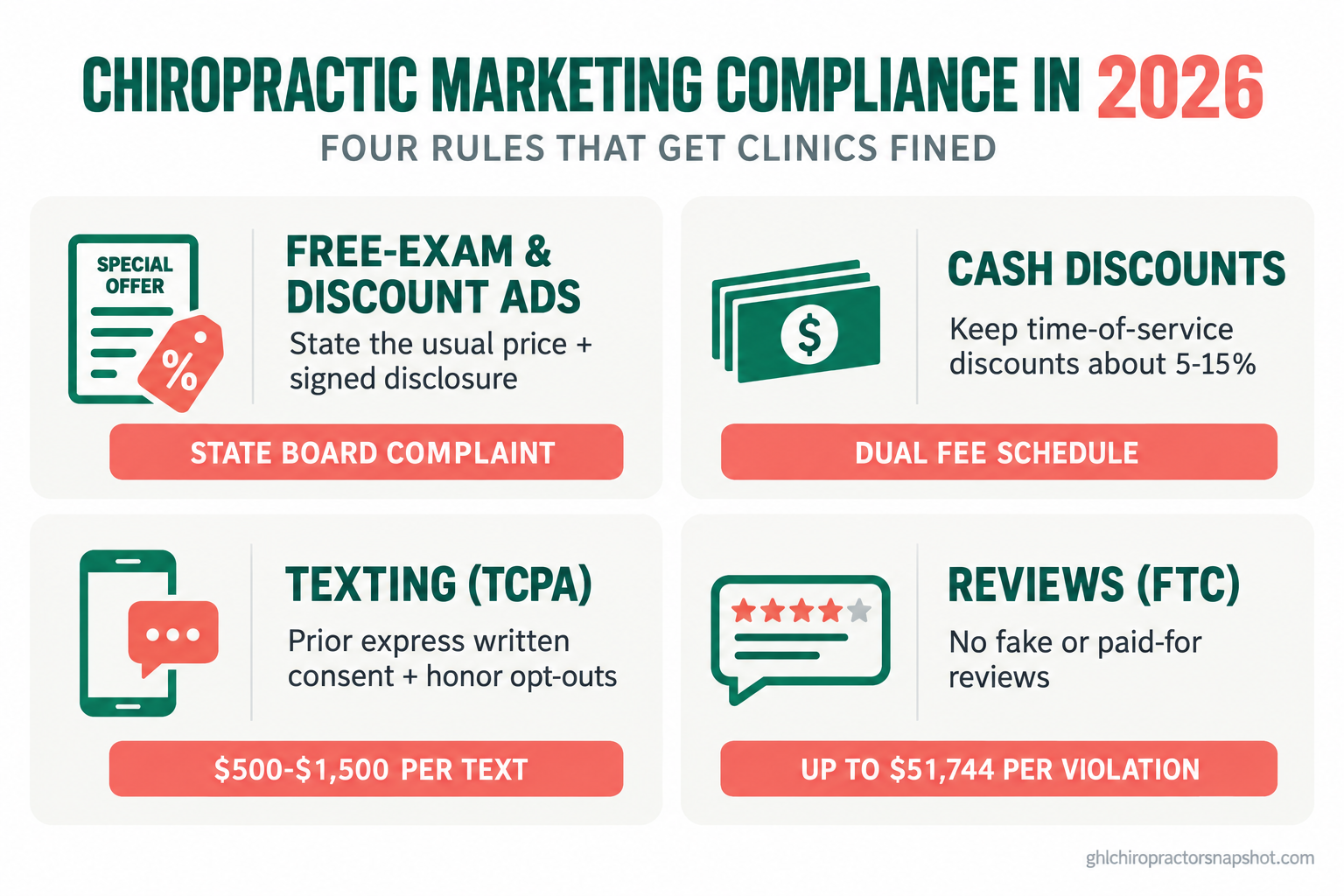
The short version. You can market your chiropractic practice aggressively and legally at the same time. What trips clinics up is not the marketing, it is four specific rules that each carry their own penalty: state board advertising rules on free and discounted services, the “dual fee schedule” problem with cash discounts, the TCPA rules on texting, and the FTC rules on reviews and testimonials. None of them bans what you want to do; each one changes how you have to do it. Get the wording right and you keep the patients and avoid the letter. Get it wrong and a single ad, text, or review becomes next quarter’s cleanup.
This is marketing-compliance guidance, not legal advice. Rules vary by state and change often, so verify each section with your own board and attorney before you launch.
Table of contents
- Why marketing compliance got riskier for chiropractors
- Can you advertise a free or discounted exam?
- How big can a cash discount be before it is a problem?
- What can you text and email patients for marketing?
- What about HIPAA when the message is marketing?
- Can you use patient reviews and testimonials?
- Solo, three-doctor, and multi-location
- Common objections
- Frequently asked questions
Why marketing compliance got riskier for chiropractors
Two things changed. The rules got sharper, with the FTC’s fake-review rule in October 2024 and the FCC’s tighter texting rules in April 2025, and the audience got more plugged in. Patients read reviews before they ever call, and a screenshot of a non-compliant ad or an unwanted 7am text travels fast.
The chiropractic market is big enough that regulators and the plaintiff’s bar both pay attention: about $24.1 billion across roughly 66,061 US businesses as of 2026 (IBISWorld, 2026), all running the same free-exam ads, discounts, and review campaigns that an enforcement agency notices.
Here is what a single mistake can cost, by rule.
Maximum statutory penalty per incident, by rule. Sources: TCPA damages of $500 to $1,500 per text (FCC); the FTC review rule, up to $51,744 per violation (FTC, 2024); HIPAA willful neglect, up to about $71,162 per violation (HIPAA Journal, 2026).
The point is that these are per-incident. Text 800 patients without the right consent and you are not looking at one $1,500 problem, you are looking at 800. Each section below takes one risk and shows the version that keeps the patient and drops the penalty.
Can you advertise a free or discounted exam?
Usually yes, but the “free exam” hook is the most regulated ad in chiropractic, and the rule is set by your state board, not by Facebook. The common thread in the strict states: if you advertise something as free or discounted, you have to say what it normally costs, and often document that the patient understood the offer.
Louisiana is the clearest example. The board’s rule allows ads offering free goods, services, or discounts only if the ad also includes the usual charge and describes exactly what is free or discounted. In print the usual charge must appear in bold type at least as large as the offer; on TV or radio it must be stated out loud. On top of that, the doctor has to give the patient a disclosure statement to sign that spells out what was free or discounted (Louisiana State Board of Chiropractic Examiners). Misleading or self-laudatory advertising is itself grounds for discipline under state law (La. R.S. 37:2816).
West Virginia takes a similar line. Its board rule requires that an ad offering free or discounted services include the usual charge, that any free diagnostic service be medically necessary, and that the patient sign a disclosure describing the offer (W. Va. CSR 4-1-6). Arizona does not single out the word “free,” but its board bans advertising that is false, deceptive, or misleading (Ariz. Admin. Code R4-7-901), and a bare “FREE EXAM” with no detail and no usual price is exactly the kind of vague claim that falls under it. The specifics differ, but the pattern repeats: name the real price, define the offer, and keep a record.
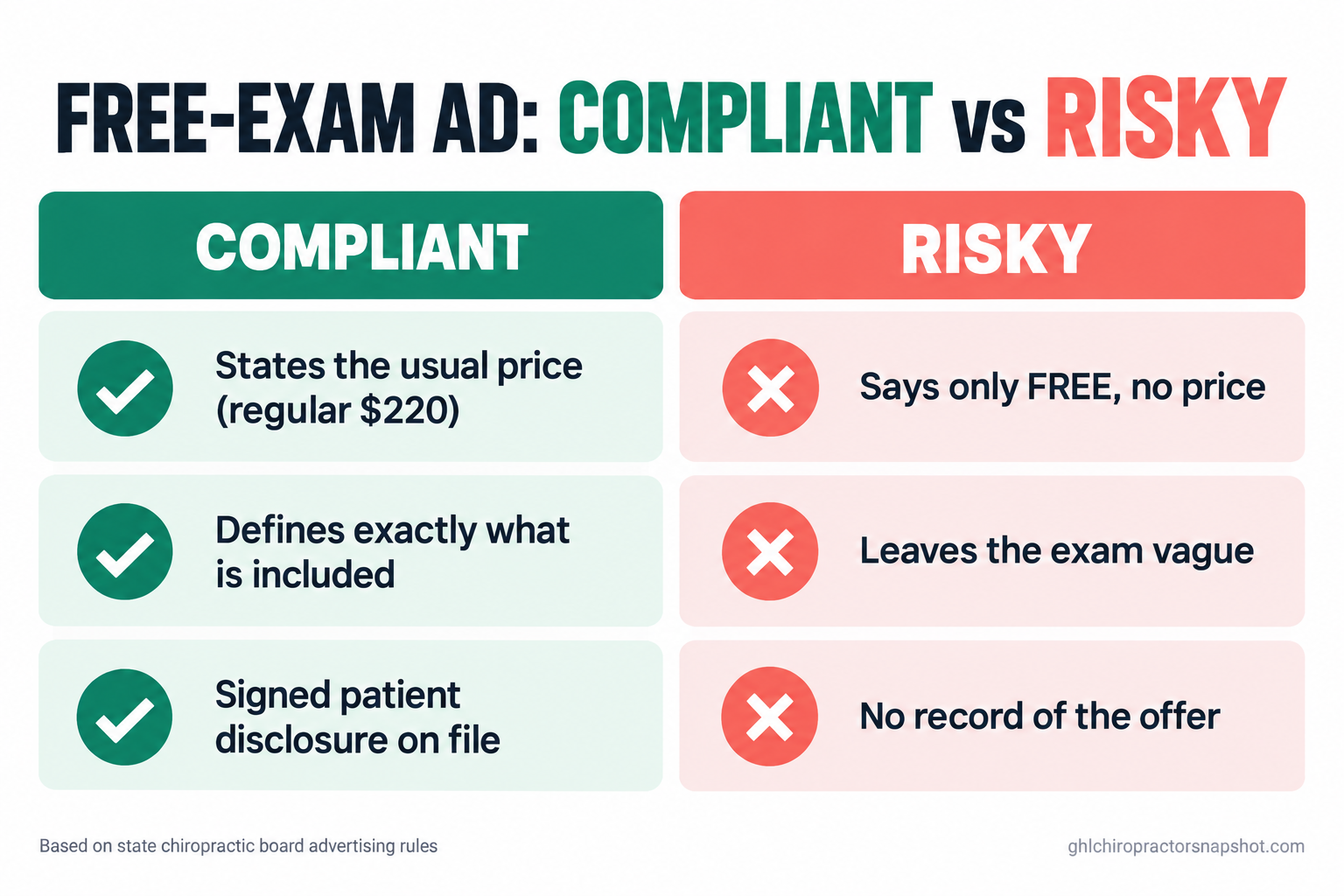
| A compliant free/discount ad | A risky one |
|---|---|
| States the usual price (“regular $220”) | Says only “FREE” with no price |
| Defines exactly what is included | Leaves “exam” vague and open-ended |
| Has a signed patient disclosure on file | Keeps no record of the offer |
The failure mode is quiet and then sudden. Nobody stops the ad on day one. A competitor or unhappy patient files a complaint, the board pulls the ad, and you are explaining to a regulator why your “free X-ray” offer never mentioned the series runs $240. The fix costs a few extra words.
How big can a cash discount be before it is a problem?
This one surprises people, because the risk is not advertising law, it is insurance law. If you bill insurance for some patients and give a steep cash discount to others, you can create what compliance people call a “dual fee schedule,” where your “real” fee looks far lower than what you tell insurers. The fraud concern is that your billed charge to the payer is not actually your usual and customary fee.
No statute sets a magic number here, but the widely followed guidance is to keep time-of-service cash discounts modest, commonly cited around 5% to 15%, applied uniformly through a written policy rather than ad hoc at the front desk (Illinois Chiropractic Society). The federal Office of Inspector General has treated prompt-pay discounts as acceptable when they are not advertised, are disclosed at the time of billing, bear a reasonable relationship to the collection costs you avoid, and the payers are notified (Cohen Healthcare Law). Larger or advertised discounts should run through a registered discount medical plan organization, which exists so clinics can offer documented discounts without the dual-fee problem.
The practical rule: a 10% time-of-service courtesy applied to every self-pay patient under a written policy is defensible. A “pay cash and I’ll knock $150 down to $40” arrangement is what gets a clinic in trouble. The discount is not the problem. The inconsistency and the size are.
What can you text and email patients for marketing?
Texting is the highest-return channel a clinic owns and the easiest place to collect a lawsuit. The law is the TCPA, and the key distinction is between a care message and a marketing message.
A care-related message, like an appointment reminder or recall nudge, sits under a lighter consent standard. A marketing message, like a discount offer, a new-service announcement, or a “we miss you, book now” blast, requires prior express written consent: a written agreement where the patient clearly agrees to receive marketing texts, naming your clinic, with a signature or electronic opt-in on file. A checkbox that says “yes, text me reminders” does not cover a 50%-off promo blast.
Two more rules matter. Since April 11, 2025, the FCC requires you to honor an opt-out made by any reasonable method, not only the word STOP, so “please stop” or “take me off this” is a valid revocation you have to act on quickly (FCC). And the TCPA restricts solicitations to between 8am and 9pm in the recipient’s local time, so a 7am blast is a problem even if everything else is right.
For what you may put inside a message once you have permission, our HIPAA-compliant patient texting guide covers the content rules, and the TCPA-compliant SMS playbook goes deeper on consent. Permission first, content second.
The failure mode multiplies. TCPA damages run $500 to $1,500 per text, and plaintiffs’ attorneys actively hunt for businesses that blast marketing without written consent. A list of 800 patients texted without proper opt-in is not one risk, it is 800.
What about HIPAA when the message is marketing?
HIPAA and the TCPA solve different problems, and marketing lands in the overlap. The TCPA governs permission to contact. HIPAA governs the health information inside the message and whether you can use patient data to target marketing.
Under the HIPAA Privacy Rule, using protected health information for “marketing” generally requires the patient’s written authorization, with narrow exceptions like a face-to-face conversation or a reminder about their own treatment (HHS). The line that matters for a clinic: a recall reminder to come back for care is treatment communication and is fine. Pulling a list of everyone with a specific diagnosis to push a new paid program is marketing that uses PHI, and that needs authorization.
The second HIPAA trap is content. Even a legitimate message cannot leak a diagnosis, condition, or treatment detail into a plain SMS or email. “Time for your next adjustment” is fine. “Time to restart your sciatica decompression plan” names a condition and a treatment, and now a routine nudge is a privacy issue. Keep clinical detail out of the message body entirely.
The practical takeaway: segment lists by appointment behavior, not by condition, and get written authorization before running anything that uses health data to sell. A patient reactivation campaign built on “we haven’t seen you in a while” rather than “your back condition” stays clean on both counts.
Can you use patient reviews and testimonials?
Reviews are the most powerful marketing a clinic has, because patients read them before they call, and the rules got much stricter in late 2024. The FTC’s final rule banning fake and misleading reviews took effect October 21, 2024, with penalties up to $51,744 per violation (FTC, 2024).
Here is what the rule prohibits. You cannot write or buy fake reviews, including anything AI-generated or from people who were never patients. You cannot incentivize reviews in a way that biases them, which is where the “$10 gift card for a five-star review” idea becomes a problem. You cannot have staff post reviews without disclosing they work for you. And testimonials you feature in your marketing have to be genuine and reflect typical results, not a cherry-picked miracle case presented as the norm.
On top of the FTC rule, some state boards separately restrict testimonials in chiropractic advertising, so a patient success story can be a board issue even when it is perfectly real. Verify your board’s stance before building an ad around testimonials.
None of this means stop collecting reviews. It means change how you ask. You can ask every patient for an honest review; you cannot condition a reward on the rating or on leaving one. The right move is a neutral, well-timed request to everyone, which is how a compliant review-generation system is built, and how our automated review requests stay on the right side of the line.
Solo, three-doctor, and multi-location
The rules are the same at every size. The burden, and where it breaks, is different.
Solo DC with one or two staff. Your risk is informality: the free-exam sign in the window, the text blast from a personal phone, the gift card for reviews, all done fast with no documentation. Write down three things once: your advertising disclosure language, your discount policy, and your consent process. A solo clinic rarely gets caught doing something exotic. It gets caught doing the ordinary thing without the paper trail.
Three-doctor practice. Now the problem is consistency. Three providers mean three sets of instincts about what to put in an ad or offer a cash patient, and one associate’s “pay cash, I’ll take care of you” undoes the policy the practice thought it had. The win is a single shared playbook: one consent form, one discount policy, one review script.
Multi-location. Exposure scales with your list size and ad spend. A promo text to a combined 5,000-patient database without clean, per-location consent records is the kind of volume that attracts a class action rather than a complaint. Multi-location groups need centralized consent tracking, auditable opt-out handling, and one marketing approval process across sites. The rules did not change. The number of times you can get them wrong did.
Common objections
“Everyone in my town runs free-exam ads without all this.” Probably true, and most of them are one complaint away from the same conversation. Enforcement is complaint-driven, so you are fine until a competitor or an unhappy patient decides otherwise. Adding the usual price and a signed disclosure costs you nothing, and it tends to convert better, because naming the real value makes “free” feel like a bigger deal.
“I already have STOP in my texts, so I’m covered.” STOP handling is necessary but not sufficient. The bigger exposure is consent on the front end: a marketing blast to people who only agreed to appointment reminders. And since April 2025, STOP is no longer the only opt-out you must honor, so “quit texting me” revokes consent whether or not they typed the magic word.
“Do I need a lawyer for all of this?” For the wording here, mostly no, you need written policies and a system that enforces them. For your state board’s rules, the cash-discount limit that is safe with your payers, and testimonials in paid ads, a short review with a healthcare attorney is worth it. This guide covers national patterns. Your board and payer contracts are local.
“This is going to kill my marketing.” It does the opposite. Compliant marketing is more durable because it does not get pulled, and it usually performs better: a real price makes a discount credible, neutral review requests produce more reviews than bribing a few, and clean consent gives you a list you can mail to for years.
Frequently asked questions
Is it legal for chiropractors to advertise a free exam?
In most states yes, but several regulate it tightly. The common requirement is that the ad disclose the usual charge and that the patient sign a disclosure describing the offer. Louisiana and West Virginia have explicit disclosure rules, and Arizona bans vague or misleading claims. Confirm your own state board's rule first.
How big can a cash discount be before it becomes a dual fee schedule?
Compliance guidance keeps time-of-service cash discounts modest, commonly cited around 5% to 15%, applied uniformly under a written policy. The risk is not the discount itself but pricing self-pay so far below your billed insurance charge that your usual-and-customary fee looks misrepresented. Verify the limit with your state and payers.
Do I need written consent to text patients marketing offers?
Yes. Promotional texts require prior express written consent under the TCPA: a signed or electronic agreement that names your clinic and authorizes marketing messages. A reminder opt-in does not cover marketing blasts. Appointment reminders sit under a lighter standard, but discount offers and promotions do not.
Can I offer a gift card for a Google review?
No. The FTC rule that took effect in October 2024 prohibits incentivizing reviews in a way that biases them, and conditioning a reward on leaving a review or a positive rating is exactly that. Ask every patient for an honest review, but do not pay for the rating or screen out unhappy patients before they reach the public link.
What is the difference between a HIPAA issue and a TCPA issue in marketing?
The TCPA governs permission to contact someone and how they opt out. HIPAA governs the health information inside the message and whether you can use patient data to target marketing at all. A promo text can satisfy the TCPA and still violate HIPAA if it names a diagnosis or uses a condition-based list without authorization.
The Monday-morning version is simple. Keep the free-exam ad, but name the regular price and sign the disclosure. Keep the discount, but make it a written policy for every self-pay patient. Keep the text program, but collect real marketing consent and honor every opt-out. Keep asking for reviews, but ask everyone and pay no one for the rating. You lose nothing you wanted, and stop being the clinic answering a letter next quarter.