

What does ChiroTouch actually cost in 2026? The published rate is $159 per provider per month for the Core plan and $299 per provider per month for the Advanced plan (Capterra, 2026). The number you really pay is much higher once you add a one-time implementation fee of roughly $2,000 to $5,000, data migration, per-provider charges as you grow, paid add-ons for texting and online forms, a payment-processing markup, and a yearly price bump. Independent teardowns put the three-year total near $40,000 to $45,000 for a three-doctor practice (ITQlick, 2026). This is the honest breakdown, line by line.

Here is the problem every clinic owner runs into. You ask ChiroTouch what it costs, and instead of a price you get a calendar link for a demo. The monthly figure they lead with is only the part that shows. The setup fee, the per-provider math, the add-ons, and the card-processing cut all arrive later. This guide is for the solo DC and the small multi-doc practice trying to budget honestly, and for the agencies that help them choose. Every figure below is dated and linked to its source.
Table of contents
- What ChiroTouch actually costs in 2026
- The add-ons that stack on top
- The hidden costs nobody quotes you
- What ChiroTouch really costs: three scenarios
- The payment-processing markup that costs the most
- ChiroTouch vs the alternatives on price
- The questions to ask before you sign
- Your software bill is not your biggest number
- Common objections
- Frequently asked questions
What ChiroTouch actually costs in 2026
Start with the two numbers ChiroTouch will confirm if you push. The Core plan is $159 per provider per month and includes scheduling, SOAP notes, billing, and the Rheo AI assistant. The Advanced plan is $299 per provider per month and adds electronic claim submission, ERA auto-posting, and claims scrubbing (Capterra, 2026). There is also a bundle tier with custom pricing, which is another way of saying: get on a call.
Two words do most of the damage: per provider. That is not a flat clinic fee. If you bill insurance you almost certainly need Advanced, because Core does not scrub claims. And the day you add an associate, your software line does not tick up a little. It re-multiplies.
The published rate is also not stable. Review sources that track renewals report annual increases near 5%, so the number on your first invoice is the lowest one you will ever see (ITQlick, 2026). What is unusual is how hard it is to see the full picture before you commit, which is exactly why ChiroTouch, along with Weave, shows up on every “hidden pricing” list.
The add-ons that stack on top
The list price buys the core system. A working clinic needs more, and each piece is its own line.
- Text and email reminders. Automated reminders and recall messaging are commonly sold as an add-on, and they are the most-used feature at a busy front desk.
- Online intake and digital forms. The paperless intake patients now expect is frequently a separate module.
- Online scheduling. Self-booking is not always in the base tier.
- Extra providers. The biggest silent multiplier. Two associates on Advanced is $897 a month before anything else.
- Payments. CTPayments is the built-in processor, and its cut gets its own section below because it is the line owners underestimate most.
None of these are exotic. They are the features that make the software usable day to day. The trouble is the “$159” a prospect remembers rarely includes any of them, so the first real invoice lands well above the number in their head.
The hidden costs nobody quotes you
These are the costs that appear on no pricing page and often not in the first quote either.
Implementation and onboarding. Getting live is a project, and it is billed like one. Reported implementation fees run $2,000 to $5,000, with data migration adding $500 to $3,000 depending on how many years of records you move (ITQlick, 2026). It is a one-time hit, but it lands in year one on top of everything else.
Annual price increases. A roughly 5% yearly bump compounds. Over a three-year window it quietly adds a full extra month or two of cost that nobody modeled.
Contract length and auto-renewal. These contracts frequently run annually and renew automatically unless you cancel inside a notice window. Miss the window and you are locked in for another term. Read the renewal clause before you sign, not after.
The cost of leaving. This is the one that traps people. When you want to switch, getting a clean export of your own patient and billing data can involve fees and delays. Ask what a full export costs, and in what format, before you are a customer, because your bargaining power is highest before you sign.
What ChiroTouch really costs: three scenarios
The right number depends on how many providers you run. Here are three honest three-year estimates, each on the Advanced plan (what an insurance-billing clinic needs), using midpoints of the reported setup and migration ranges and a 5% annual increase. These are estimates built from cited ranges, not quotes, and they exclude payment markup, which is covered next.
Solo practice, 1 provider. Advanced at $299 a month is about $3,588 in year one, rising with the annual bump to roughly $11,300 across three years. Add a $3,000 implementation and a $1,500 migration and you land near $15,800 over three years, or about $439 a month all in.
Small group, 3 providers. Three seats of Advanced is $897 a month, roughly $33,900 in software across three years with the annual increase. Add a larger $3,000 setup, a $2,500 migration, and about $3,600 in add-ons over the period, and you reach roughly $43,000 over three years. That matches the independent teardown figure of $40,000 to $45,000 for a three-doctor practice (ITQlick, 2026).
Larger clinic, 6 providers. Six seats is $1,794 a month, about $67,900 in software over three years. Add $4,000 setup, $3,000 migration, and roughly $7,200 in add-ons, and you are near $82,000 over three years.
The payment-processing markup that costs the most
Here is the line most owners never model, and it is often the largest of all.
ChiroTouch’s built-in processor, CTPayments, is powered by a third party, and the platform takes a cut on top. One chiropractor’s real statement showed an effective rate of about 3.34%, where a straight interchange-plus arrangement would have landed near 2.10% (Merchant Cost Consulting, 2026). That is a gap of roughly 1.24 percentage points.
That gap is a percentage of everything you collect on a card:
For a three-doctor group, that markup alone can top $8,900 a year, which over three years rivals the base software cost. Bundled payments feel convenient, and for some clinics the reconciliation is worth it. Just price it honestly: a percentage on all card revenue is not a footnote.
ChiroTouch vs the alternatives on price
ChiroTouch is a mature, billing-grade system, and for a busy insurance practice that is a real reason to consider it. But on price and transparency it sits at the top of the market, and there are cheaper, more open options depending on what you need.
Chiropractic software pricing at a glance (2026)
| Plan | ChiroTouch | Jane | ChiroFusion | zHealth | Weave |
|---|---|---|---|---|---|
| Price | $159–$299 / provider / mo | from CA$54–$99 / mo | $149–$329 / mo | from $129 / provider / mo | $199–$600+ / mo / location |
| Feature 1 | Book-a-demo pricing, not published | Transparent, published pricing | Published pricing; +$49/mo per extra provider | Chiropractic EHR with built-in payments | Phones and messaging, not an EHR |
| Feature 2 | Priced per provider (multiplies as you grow) | First practitioner included; extras add on | Chiropractic-specific EHR and billing | Per-provider pricing, published tiers | Sales-gated tiers above the published entry |
| Feature 3 | $2k–5k setup + data migration | AI Scribe and insurance billing are add-ons | Essentials from $129/mo billed annually | Automated reminders and reviews included on higher tiers | ~$750 setup, $200 to upload existing forms |
| Feature 4 | Billing-grade EHR; CTPayments markup applies | Loved for ease of use | Lower entry cost than ChiroTouch | Mid-market pricing | Pairs with, does not replace, an EHR |
Sources: ChiroTouch (Capterra, 2026), Jane (2026), ChiroFusion (2026), zHealth (2026), Weave (G2, 2026). Jane prices in CAD.
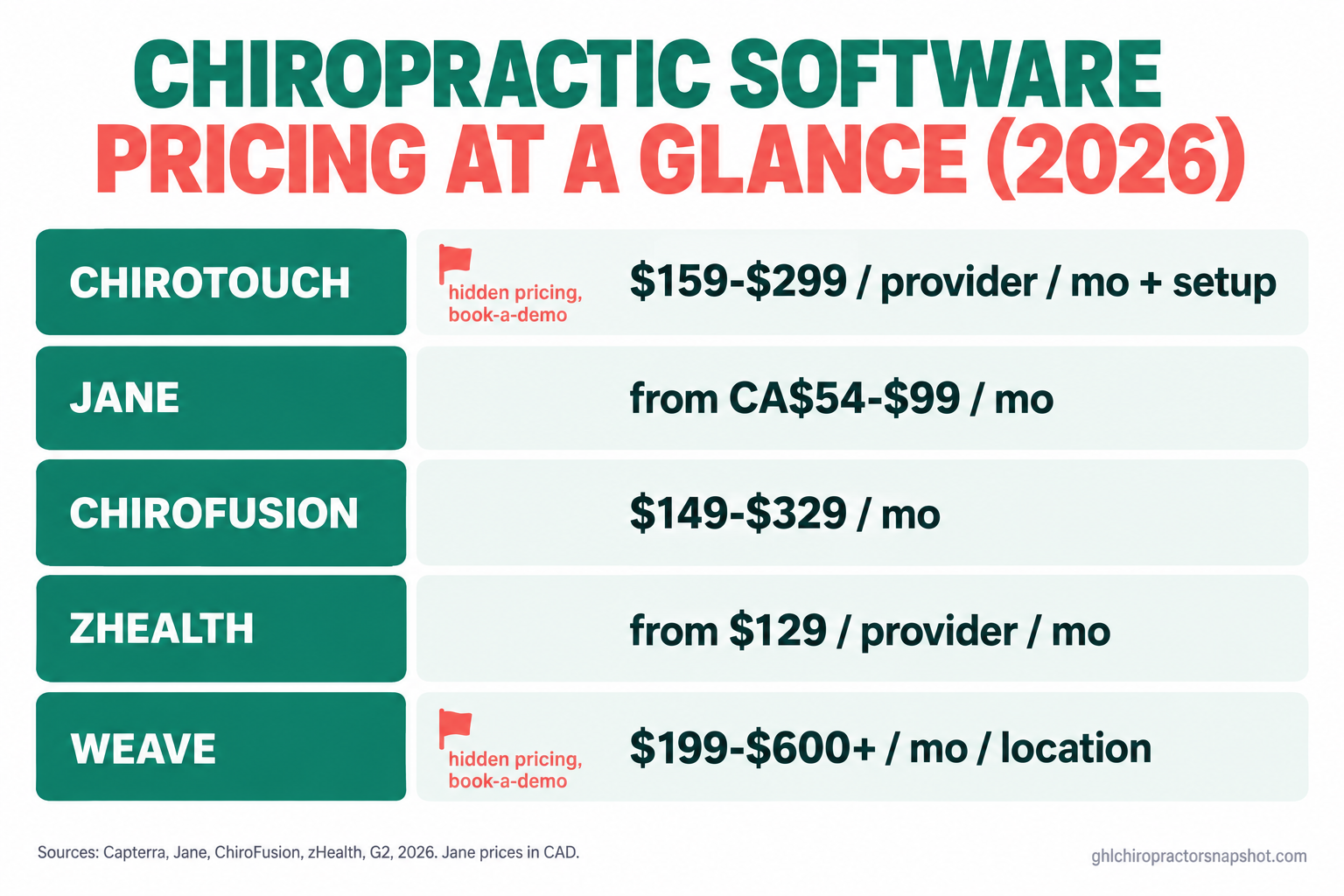
Who each one is actually right for: ChiroTouch fits a multi-doctor, insurance-heavy practice that wants one billing-grade system and can absorb the cost. Jane fits a cash or hybrid clinic that values a clean, published price. ChiroFusion and zHealth fit chiropractic-specific practices that want lower entry pricing without a demo gauntlet. Weave is not an EHR at all; it is phones and messaging that sit alongside your records system, so comparing it head to head with ChiroTouch is a category error. For a fuller walkthrough, see our best chiropractic software buyer’s guide.
The questions to ask before you sign
Because the price is not published, your best defense is a script. Take this to any demo, for any vendor, and refuse to move forward until every line has a written answer. Copy it, paste it into the follow-up email, and ask them to confirm in writing.
A vendor that answers all of that plainly is one you can trust. One that keeps steering you back to “let’s get you started” is telling you something too.
Your software bill is not your biggest number
Here is the reframe that changes the decision. The license is a knowable, boring number. The expensive number is the revenue your systems quietly let slip: the new-patient call that rang while the front desk was rooming someone, the no-show nobody chased, the care-plan patient who drifted off after visit six.
Those leaks dwarf a software bill. A single new patient can be worth well over a thousand dollars in lifetime value, and a busy solo clinic loses several a month to missed calls and dropped follow-up alone. That is a bigger line than ChiroTouch, Jane, or any of them, and most clinics never put it on a spreadsheet. In a $24.0 billion industry across about 66,061 businesses (IBISWorld, 2026), the clinics that win are not the ones with the cheapest EHR. They are the ones that stop leaking patients.
An EHR and a growth system are two different jobs. ChiroTouch keeps the records and files the claims. It was never built to text back a missed call in 30 seconds, run a reactivation campaign, or recover a no-show automatically. That work lives in your appointment automation, SMS follow-up, and patient CRM and workflows, and it is usually where the money is.
Whatever records system you run, keep the patient messaging HIPAA-aware and TCPA-conscious: no diagnosis, condition, or treatment detail in plain SMS or email, written notice to patients about the risk of unencrypted messages first, and a clean opt-out on every automated text. Cheaper software does not mean cutting those corners.
Common objections
“I already pay for ChiroTouch. Is this article telling me to rip it out?” No. If ChiroTouch works for your billing and your team knows it, keep it. Price it honestly at renewal, negotiate the payment rate and an annual-increase cap, and drop add-ons you do not use. Then put a real growth system next to it, because that is the line actually costing you.
“Isn’t switching EHRs a nightmare?” Switching your system of record is a genuine project, which is exactly why the “cost of leaving” question matters before you sign anything new. If you do move, a planned migration protects every record. See our GoHighLevel migration guide for the full playbook.
“Do I need to be technical to compare this stuff?” No. You need the question script above and the discipline to make every vendor answer in writing. Wiring up the automation is what a done-for-you system or a GHL development partner handles. Your job is to know your real all-in number.
“Is cheaper software just worse?” Not automatically. Jane and ChiroFusion publish their prices and are well regarded, and a cash-based solo clinic may be over-buying with a full billing-grade EHR it barely uses. “Worse” depends entirely on the jobs you actually need done. Match the tool to the work, not to the brand name.
Frequently asked questions
How much does ChiroTouch cost per month in 2026?
The published rate is $159 per provider per month for the Core plan and $299 per provider per month for the Advanced plan (Capterra, 2026). Your real monthly cost is higher once you add reminders, forms, self-booking, and payment processing, and it multiplies with each additional provider.
Does ChiroTouch charge a setup or implementation fee?
Yes. Independent sources report a one-time implementation fee of roughly $2,000 to $5,000, plus $500 to $3,000 to migrate your existing data into the system, depending on how many years of records you move (ITQlick, 2026).
Is ChiroTouch priced per provider or per clinic?
Per provider. Both the Core and Advanced plans are billed per provider per month, so adding an associate re-multiplies your monthly software cost rather than adding a small flat fee.
What is the cheapest ChiroTouch alternative for a solo chiropractor?
For a cash or hybrid solo clinic, Jane (from CA$54 to CA$99 a month) and ChiroFusion (from about $129 a month billed annually) publish lower entry prices. The right choice depends on whether you need full insurance billing; match the tool to the jobs you actually run.
Does ChiroTouch require a long-term contract?
Practice-management contracts commonly run on annual terms with automatic renewal. Read the term length, the renewal clause, and the cancellation notice window before signing, and ask whether month-to-month is available.
What does it cost to leave ChiroTouch and export my data?
Ask before you sign, because your bargaining power is highest then. Getting a full, clean export of your patient and billing data can involve fees and lead time. Confirm the cost and the file format in writing as part of your evaluation.
Is ChiroTouch worth it?
For a multi-doctor, insurance-heavy practice that wants one billing-grade system and can absorb the cost, it can be. For a lean solo or cash practice, a lower-cost EHR plus a dedicated growth-automation system often delivers more for less.
Related reading
- The best chiropractic software in 2026: a buyer’s guide
- How to migrate to GoHighLevel without losing a patient record
- How to reduce no-shows at a chiropractic clinic
- Missed-call text-back: turn every missed call into a booked visit
Price the full number, not the headline. Then put the bulk of your attention where the bigger money is: keeping the schedule full and the patients on plan.