

The Report of Findings is the single visit that decides whether a new patient becomes a care plan or a one-time exam you never see again. A ROF converts when you restate the patient’s own complaint in their words, show them the finding instead of describing it, name the three phases of care so relief does not feel like the finish line, present one clear recommendation with the number attached, then stop talking and let them read. Do those five in order and case acceptance climbs; skip any one and the patient ghosts. Here is the exact script, stage by stage, with the messages to steal and the ways each stage breaks.
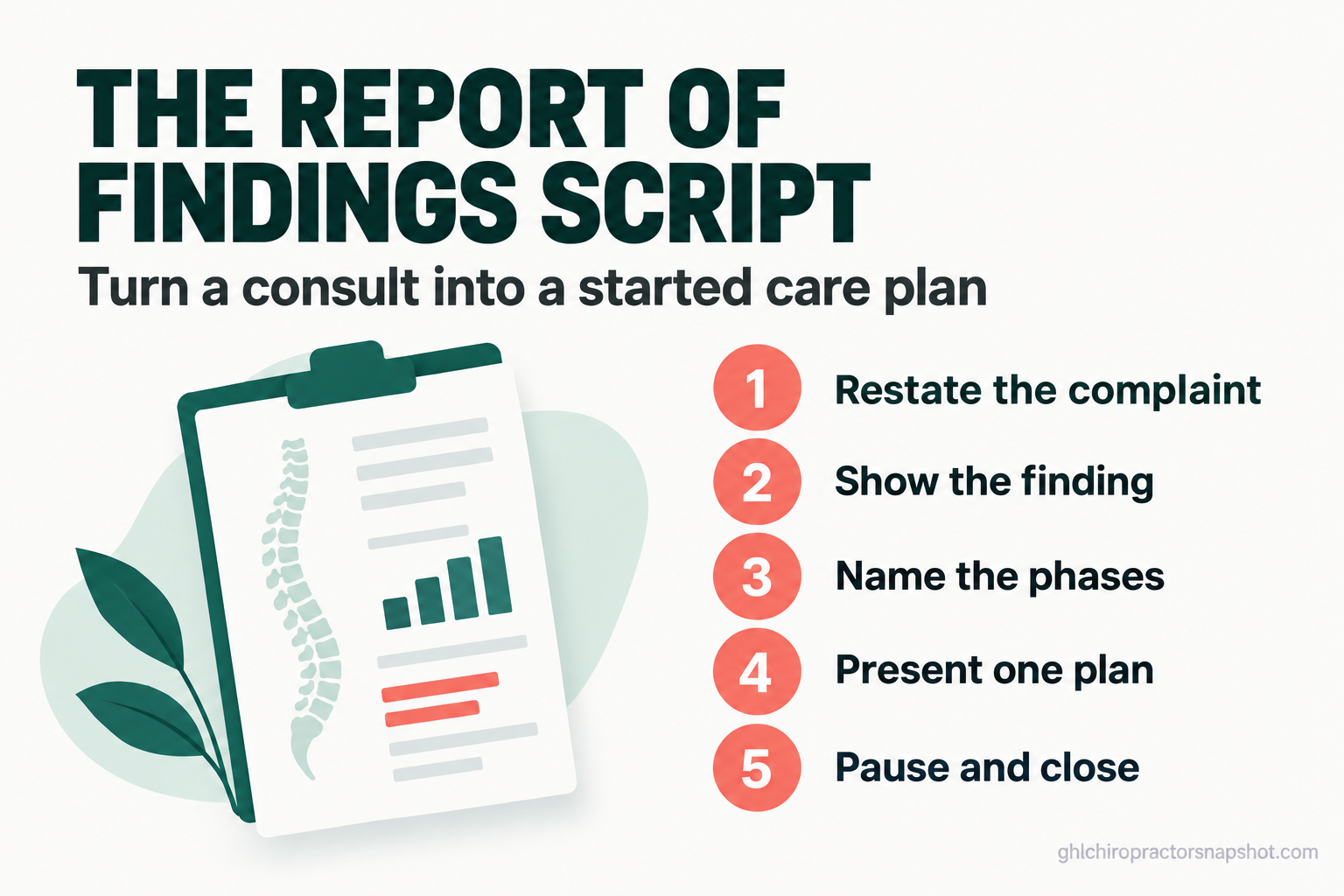
It is 8:50 on a Tuesday. Sarah is in room two for her Report of Findings. Her intake said eight months of low back pain that flares when she lifts her three-year-old, and her exam is textbook, the kind of case you can genuinely help. Twelve minutes later she is at the front desk saying she wants to “check with her husband” and book later. She never rebooks. You did nothing wrong clinically. You lost her in the room, during the one conversation built to keep her. This is not a marketing or pricing problem, it is a communication and follow-through problem, and it is fixable with a script and a system.
Table of contents
- What a weak Report of Findings costs you
- Why the plan you explained never sticks
- The five-stage ROF script
- Steal this: the messages around the ROF
- Run the ROF three ways: cash, insurance, multi-doc
- Staying compliant: HIPAA, TCPA, and ad rules
- Common objections
- Frequently asked questions
What a weak Report of Findings costs you
Chiropractic in the United States is a $24.0 billion industry across about 66,061 businesses (IBISWorld, 2026), and the Gallup-Palmer national survey put patient volume at 33.6 million adults, about 14%, in a year (Gallup / Palmer College, 2015). Patients are not the problem. The leak is what happens after they walk in.
The ROF is the exact hinge of the practice. Before it, a person is a curious lead. After it, they are a committed care-plan patient worth months of visits, referrals, and reviews, or they are gone. A solo doctor seeing 80 to 150 visits a week does not have a volume problem. They have a conversion problem hiding inside a handful of ROFs a week that never turn into plans. A patient who never commits at the ROF is also the one who no-shows later, because they never bought in. Missed appointments in primary care average 15.2% (Parsons, Bryce and Atherton, BJGP 2021), and across outpatient specialties the figure is closer to 23% (Dantas et al., Health Policy 2018). A weak ROF feeds that number. Vendor data agrees: ClinicMind puts national chiropractic retention around 20%, with most drop-off decided in the first two visits (ClinicMind, 2026). Treat that as directional, but the second visit is the ROF.
Why the plan you explained never sticks
Here is the uncomfortable research. Patients forget between 40% and 80% of the medical information a clinician gives them, immediately, and nearly half of what they do retain is remembered incorrectly (Kessels, 2003). You explain a subluxation pattern and a 24-visit plan clearly, and the patient still walks out having lost most of it, then lets anxiety about cost harden the “maybe” into a “no.”
The fix is to talk less, show more, and confirm the patient can say the plan back in their own words before they leave. That last part is teach-back, which the Agency for Healthcare Research and Quality treats as a core tool for confirming a patient understood what they agreed to, paired with shared decision-making, where the patient helps choose the plan (AHRQ Teach-Back, Tool 5; SHARE Approach). Every stage below is built to beat the forgetting curve.
The five-stage ROF script
Run these five stages in order, every time. The order matters as much as the words.
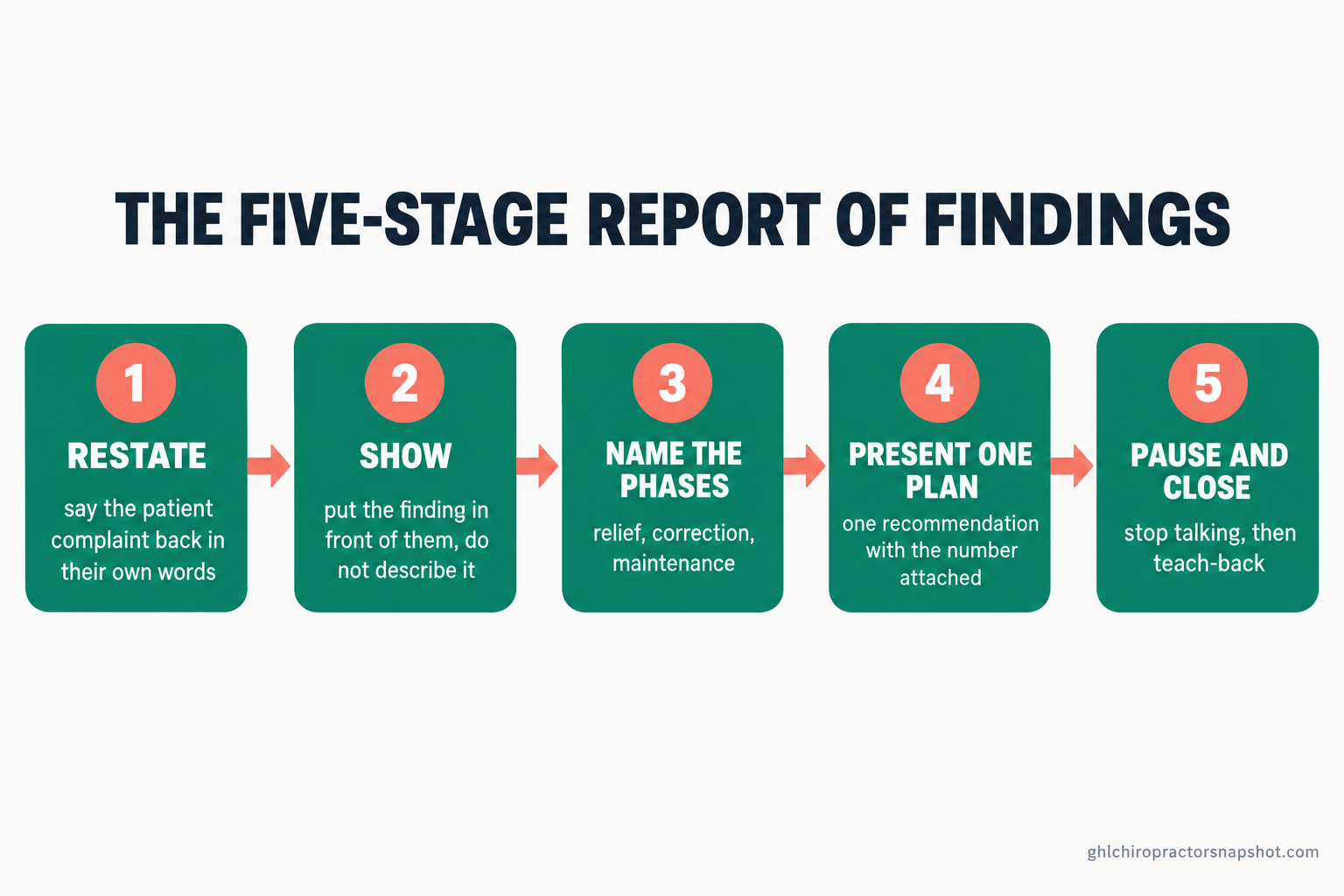
Stage 1: Restate their complaint in their own words
Before you show a single image, prove you heard them. Pull the language from their intake and hand it back.
“Before I show you anything, I want to make sure I have this right. You came in because of the low back pain that flares when you lift your daughter, and it has been going on about eight months. Is that still the main thing you want handled?”
Then wait for the yes. It lowers the guard and anchors the whole visit to their goal, so everything you recommend becomes “here is how we fix the thing you just confirmed,” not “here is what I found.”
How this stage breaks: you lead with the spine model before the patient feels heard, and they spend the visit wondering whether you understand their problem. Never open with a finding, open with their words.
Stage 2: Show the finding, do not describe it
This is where the forgetting curve gets beaten. Put the image, posture scan, or range-of-motion result in front of them and point.
“Here is your scan. This line is where a healthy curve sits. This is yours. I am not going to bury you in terms. The short version is that this joint is not moving the way it should, and that is why the pain keeps coming back to the same spot.”
Keep it to one or two findings that map directly to their complaint. A patient who leaves with one vivid picture remembers more than one who got a ten-minute anatomy lecture. Give them one thing they can repeat to their spouse tonight.
How this stage breaks: you over-explain. Three findings, five clinical terms, a tangent about the nervous system, and the one image that mattered is buried. Pick the clearest visual and stop there.
Stage 3: Name the three phases so relief is not the finish line
This is the stage most doctors skip, and it prevents the early walkaway. Say out loud that care has phases and that feeling better comes before being fixed.
“There are three phases here. Relief, where we calm the pain down. Correction, where we actually change how the joint moves so it stops coming back. And maintenance later, which is optional. Most people feel better during relief and think they are done. That is the trap, because the thing causing it has not changed yet.”
Now the patient has a mental model. When their pain drops at visit five, they do not think “I am cured,” they think “I am in the relief phase.” You have inoculated them against the most common reason patients quit early, the same drop-off we break down in the care-plan cliff at visit 14.
How this stage breaks: you never mention phases, so relief reads as completion, and the walkaway you later call attrition was really a framing gap on day two.
Stage 4: Present one plan, with the number attached
Give one clear recommendation, not a menu. A menu makes the patient a shopper. One recommendation keeps you the doctor.
“For where you are, I am recommending a plan of a set number of visits over the next several weeks. Here is the plan on paper, and here is what it costs and how it works with your coverage. Take a second to read it.”
Hand them the printed plan. Seeing the number in writing does more than saying it. And say the price plainly, like the schedule, a normal fact of the plan.
Stage 5: Pause, then close with teach-back
You have presented the plan and the number. Now stop talking. The instinct to fill the silence is what loses plans. Ask an open question and wait.
“What questions do you have?”
Not “does that make sense,” which invites a polite “yep” and a walkout. “What questions do you have” assumes they have some and gives them room to raise the real objection while you are still there. When they answer, lock it in with teach-back:
“Just so we are on the same page, tell me in your own words what the plan is and why we are doing it.”
If they can say it back, they own it. If they cannot, you found the gap before they left instead of after. And if they say “I need to think about it,” do not accept the fog. Ask what specifically they want to think through, the schedule, the cost, or whether it will work, then solve that one thing while you are still in the room. Nine times out of ten that is where consults become care plans, and it is about who talks after the price. Let it be them.
Steal this: the messages around the ROF
The best script loses to a patient who never gets a recap. These messages carry the other half of the job, and every one can fire automatically. Keep them free of any diagnosis or treatment detail so they stay HIPAA-aware in plain SMS.
Pre-ROF confirmation, sent the day before. Sets the frame so the patient arrives expecting a real conversation.
Hi {FirstName}, it's {Clinic}. You're booked {Day} at {Time} with Dr.
{Name} to go over your exam results and the plan we recommend. Please
allow about 30 minutes. Reply C to confirm or R to reschedule.
Reply STOP to opt out.
The ROF recap, sent within an hour of the visit. The highest-value message and the one almost nobody sends. It fights the forgetting curve and gives the spouse-in-the-kitchen conversation something concrete. Keep it general, no clinical detail.
Subject: Your plan from today, {FirstName}

Hi {FirstName}, great to spend time with you today. Here's the plan we
agreed on: {frequency and timeframe in plain words}. Your next visit is
{Day} at {Time}. If anything comes up before then, just reply here or
call {Phone}. Glad you got started.
Missed-ROF recovery, sent 15 minutes after a no-show. A patient who misses the results visit is not gone, they are busy. Treat it like a small fire.
Hi {FirstName}, we missed you today for your results review, no problem
at all. Dr. {Name} set aside time to walk you through everything.
What day this week works to get you back in? Reply STOP to opt out.
Those three messages, wired to your calendar to fire on the right trigger, recover more plans than any tweak to the words in the room. The patient reactivation playbook and the no-show reduction guide go deeper on timing, and they run on the same CRM workflow layer.
Run the ROF three ways: cash, insurance, multi-doc
The five stages hold everywhere, but the pressure points differ by practice type.
The cash-based solo clinic. The plan and the number arrive together, so stage four carries the most weight. You cannot lean on “insurance covers it,” so lean on the stage-two finding and stage-three phases, and the price reads as the cost of fixing a real problem rather than a subscription. A membership or care package is often the cleanest structure (membership pricing and retention math).
The insurance-billing practice. The trap is letting coverage do the convincing. When the front desk leads with “your insurance covers 20 visits,” the patient hears “free until it runs out” and treats visits as disposable, which is why insurance patients tend to no-show more. Keep the clinical why front and center, and track authorizations so no one hits their visit cap mid-correction and gets a surprise bill.
The multi-doc practice with 2 to 5 DCs. Consistency is the whole game. When one doctor runs a tight ROF and another does a rushed three-minute version, case acceptance swings by provider and you cannot see why. Standardize the script, the printed plan, and the messages, then review starts by provider monthly. The automation matters even more here because it does not depend on which doctor was in the room (patient lifetime value math), and the first-visit funnel that feeds the ROF has to be tight too.
Staying compliant: HIPAA, TCPA, and ad rules
A conversion system that ignores the rules is a liability, and patient messaging is where clinics get sloppy.
HIPAA in plain messaging. Automated SMS and email should never carry diagnosis, condition, or treatment detail. “Your plan from today” is fine, naming the condition is not. Patients should also get written notice that unencrypted text and email can be intercepted, and give consent, before you message them that way (HHS HIPAA for professionals).
TCPA on automated texts. Every automated or recurring text needs prior express consent and a working opt-out, which is why every template above ends with a STOP line (FCC on telemarketing and robocalls). Capture consent at intake and honor opt-outs instantly.
State board advertising rules on “free exam” hooks. If your funnel uses a free or discounted exam, check your state board first. Louisiana and West Virginia require the ad to disclose the usual charge and have the patient sign a disclosure, and Arizona restricts vague free-service ads. And time-of-service cash discounts generally sit in the 5 to 15% range to avoid dual-fee-schedule exposure, though it varies by state and payer, so verify your own situation rather than copying a number off a blog.
Common objections
“This feels salesy. I’m a doctor, not a closer.” The opposite is true. A vague ROF that lets a patient drift out undecided is the unkind version, because the patient with a real, fixable problem does not get fixed. Teach-back and shared decision-making are patient-communication tools, not sales tactics (AHRQ). You remove confusion, you do not apply pressure.
“My patients genuinely need time to think.” Some do, and that is fine. Stage five surfaces what they need to think about while you can still help. Most “I need to think about it” is really one concrete worry: cost, schedule, or doubt it will work. Name the three, solve the one, and the patient who truly needs to sleep on it still can, now with the recap in hand.
“I already do a Report of Findings.” Almost every doctor does. The question is whether it runs the same five stages in the same order every time, and whether the follow-up is automatic. Most ROFs are strong on the clinical show and weak on stage three and stage five, with no recap at all. The gap is rarely the anatomy, it is the framing and the follow-through.
“Do I need software to do this?” No for the room, yes for the follow-up. You can run the five stages tomorrow with the script and a printed plan, but the confirmation, the recap, and the missed-ROF recovery only fire every time if something automatic sends them, which is where a GoHighLevel workflow build earns its keep.
Frequently asked questions
What is a Report of Findings in a chiropractic practice?
It is the visit, usually the second, where the doctor reviews the patient's exam results and presents a recommended care plan. It is the moment a new patient decides whether to start ongoing care, which makes it the most important conversation in the practice.
Why do patients say they need to think about it after the ROF?
Usually one specific worry went unaddressed: cost, schedule, or doubt care will work. Patients forget 40 to 80% of medical information immediately (Kessels, 2003), so anxiety fills the gap after they leave. Naming the concern before they go, and sending a recap, resolves most of it.
What should the ROF follow-up message include?
A plain-language recap of the agreed plan, the next appointment time, and an easy way to reply, within an hour of the visit. Keep it free of diagnosis or treatment detail to stay HIPAA-aware, and include an opt-out on any automated text.
How do I stop insurance patients from no-showing after the ROF?
Do not let coverage do the convincing. Lead with the clinical reason for care, present the plan as the correct number of visits rather than what insurance allows, and track authorizations. Primary-care no-show rates average around 15% (BJGP, 2021), and weak ROF buy-in is a big driver.
Is it compliant to text patients their care plan?
You can text logistics and a general recap of the plan you agreed on, but not diagnosis, condition, or treatment detail in plain SMS. Patients need written notice about unencrypted messaging and must consent, and every automated text needs a working opt-out under the TCPA.
Related reading
- The first-visit funnel that feeds a strong ROF
- Why patients drop off at visit 14, and the workflows that fix it
- Building a lapsed-patient reactivation campaign
- Membership pricing and the real retention math
- How to reduce no-shows at a chiropractic clinic
Back to Sarah in room two. The visit that keeps her is not louder or pushier. It restates her pain in her words, shows her the one finding that explains it, names the phases so relief is not the finish line, hands her one plan with the number on it, then goes quiet and lets her choose. An hour later a recap lands on her phone so the plan does not evaporate. That is the difference between a practice that leaks and one that grows.